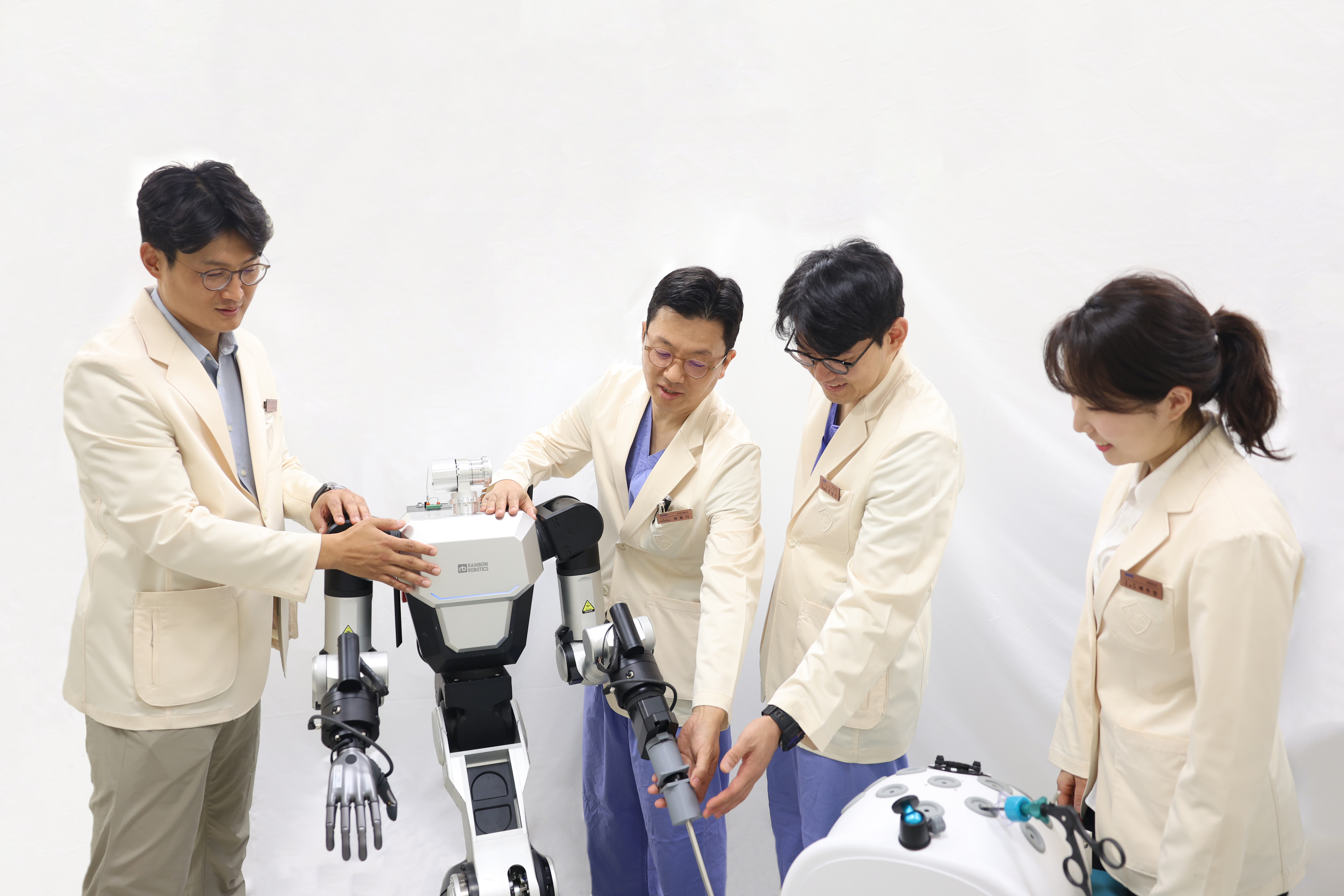
Samsung Medical Center held a symposium on the development of a humanoid-type surgical assistant robot on June 19th, 2026.
The symposium was held to share the outcomes achieved since Samsung Medical Center was selected for the "Essential Healthcare Innovation Mission Task of the 2025 First Korean ARPA-H Project," a program jointly organized by the Ministry of Health and Welfare and the Korea Health Industry Development Institute in 2025. The ARPA-H Project is a national research and development initiative aimed at addressing high-cost, high-difficulty challenges in healthcare. Under this project, Samsung Medical Center formed the "ORchestra" consortium, led by Professor Yong Gi Jung of the Department of Otolaryngology as principal investigator, to undertake the task of "Developing a Humanoid-Type Physical AI–Based Surgical Assistant Robot for an Efficient Surgical Environment."
*ORchestra (Operating Room Collaborative Humanoid: An Embedded System as a Trustworthy Robotic AI)
The ORchestra consortium includes Samsung Medical Center, the National Cancer Center, Jeonbuk National University Hospital, the Seoul National University Industry-Academic Cooperation Foundation, the Sungkyunkwan University Industry-Academic Cooperation Foundation, Rainbow Robotics, Adin Robotics, and Hahaeho.
The symposium presented the vision for the future surgical environment developed over the past year since the project's selection. Following a special lecture session for registered attendees, a second session was held for invited guests, featuring presentations on the current status of the research and a live demonstration of the humanoid-based surgical assistant robot.
The special lecture was delivered by Dr. Brian Ji Woong Kim of Stanford University on the topic of surgical robots. Dr. Kim is a leading expert in the field, whose research was featured on the cover of Science Robotics—one of the top-tier academic journals in robotics—in July of last year.
Professor Yong Gi Jung said, "Building a medical humanoid ecosystem is, I believe, one of the greatest challenges hospitals must confront in an era in which AX (AI transformation) has become a central issue." He added, "If we succeed in developing a robot that enables safer and more precise surgery, it will improve the quality of healthcare and help Korea stay ahead in this emerging industrial landscape."
Meanwhile, separate from its role leading the humanoid surgical assistant robot development project, Samsung Medical Center was also recently selected as the lead institution for the Ministry of Health and Welfare's "AI-Based Surgical Robot Innovation Lab Establishment and Utilization Project." This project is likewise headed by Professor Yong Gi Jung, who opened the "AURORA Lab (AI-Unified Robotics & Operative Research Accelerator Lab)" to provide dedicated support for the technological advancement and commercialization of surgical robots, with the aim of securing a leading position in the AI surgical robot market, a key sector of future healthcare.
With Samsung Medical Center having successively secured major AI-based surgical robot projects, the hospital expects that the synergy between the two initiatives will lay the groundwork for staying ahead in the global technological race in this field.
Professor Wooseong Huh, Director of the Future Medicine Research Institute and Deputy Director of Research at Samsung Medical Center (Professor, Department of Nephrology), said, "By combining Samsung Medical Center's world-class clinical capabilities with cutting-edge technology, we expect this to serve as a catalyst for a major leap forward in Korea's medical robotics industry." He added, "We will do our utmost to provide full infrastructure support and foster a research environment so that Samsung Medical Center can play a pivotal role across the entire spectrum of medical robot development and clinical validation, including surgical robots."