A new study has found that even when diabetes develops after kidney transplantation, restoring blood glucose to normal levels lowers the risk of death to a level comparable to that of patients without diabetes.
A research team led by Professors Wooseong Huh, Hye Ryoun Jang, and Jun Seok Jeon of the Division of Nephrology at Samsung Medical Center analyzed prognostic outcomes according to changes in diabetic status among kidney transplant recipients, publishing the findings in a recent issue of the international journal Transplant International (IF=3.0).
Using data from the National Health Insurance Service, the research team followed 8,486 kidney transplant recipients who underwent national health checkups between 2009 and 2017, tracking outcomes through 2021.
Following kidney transplantation, 2 to 3 out of every 10 patients without a prior history of diabetes are newly diagnosed with diabetes after surgery. This is because immunosuppressant use to prevent immune rejection, along with the physiological stress response immediately following surgery, affects glucose metabolism.
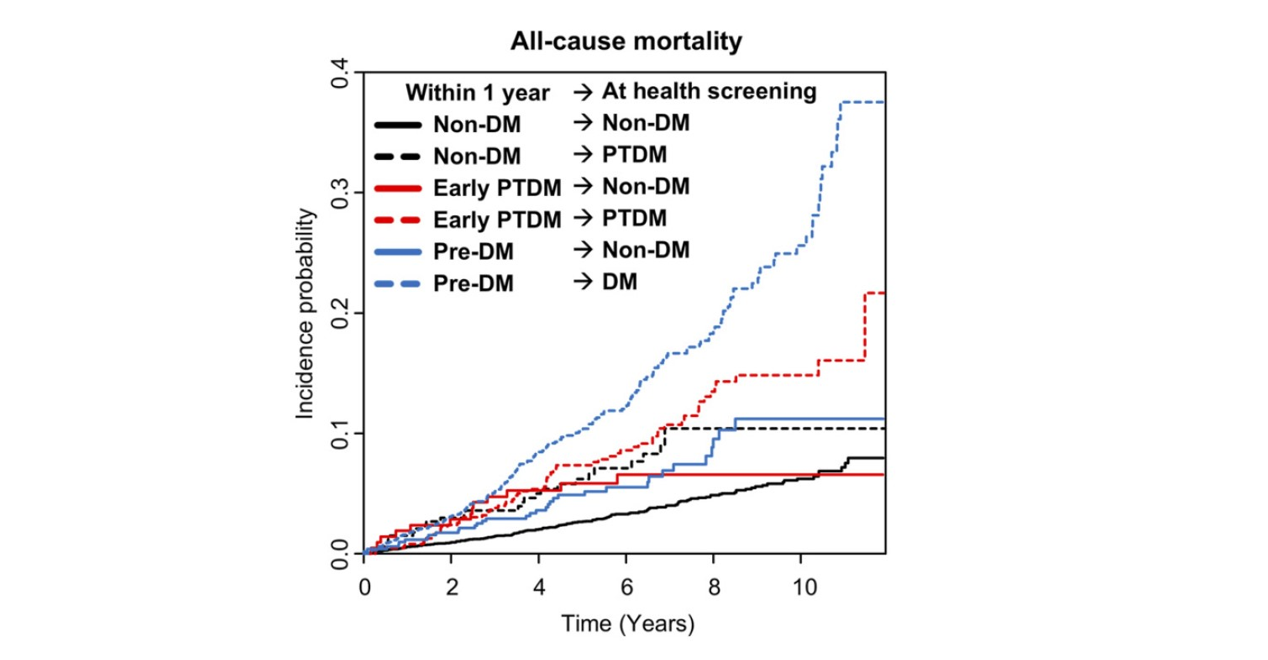
- Graph. Comparison of Mortality Rates Among Kidney Transplant Recipients According to Changes in Diabetic Status.
- Among Patients who developed diabetes within 3 months to 1 year after kidney transplantation, those who subsequently recovered to a non-diabetic state (red solid line) showed a lower risk of death than those in whom diabetes persisted (red dotted line).
According to the study, patients who developed new-onset diabetes between 3 months and 1 year after transplantation had a 30.9% higher risk of death compared to patients without diabetes, and when diabetes persisted beyond 1 year post-transplant, this risk rose to 75.5%. However, among patients whose blood glucose returned to normal, mortality risk did not increase. In fact, 33.5% of patients who developed diabetes in the early post-transplant period recovered to a non-diabetic state.
The research team explained that although blood glucose levels may rise in the early period after kidney transplantation, they can normalize as the body stabilizes and immunosuppressant dosages are adjusted.
Recovery of blood glucose levels also affected outcomes among patients who had diabetes prior to transplantation. Among these patients, 38.6% recovered to a non-diabetic state, and their mortality risk was 38.2% lower than that of patients whose diabetes persisted. Notably, patients who recovered to a non-diabetic state showed no statistically significant difference in the risk of graft failure—complete loss of transplanted kidney function—compared to patients who never had diabetes to begin with.
Professor Wooseong Huh emphasized, "This study is meaningful in showing that diabetes developing in the early period after kidney transplantation can be overcome. Even patients diagnosed with post-transplant diabetes should not become discouraged, but should continue active blood glucose monitoring and treatment."