SMC researchers develop CurConMix+, an AI model for surgical workflow recognition
A research team at Samsung Medical Center (SMC), which demonstrated the potential for collaboration between humanoid surgical assistant robots and medical staff this past September, has now developed an artificial intelligence technology that recognizes the context of a surgical scene.
The work lays a core technological foundation that intelligent surgical assistant robots will need to work alongside medical staff in the future.
The team, made up of Director Kyu-Hwan Jung and researcher Yongjun Jeon of SMC's Clinical Robotics and Embodied AI Research Center and Professor Namkee Oh of the Department of Transplant Surgery, announced that it has developed CurConMix+, an AI that draws on both spatial information and temporal context to understand surgery hierarchically, from fine-grained surgical actions to overall surgical phases.
The findings were published in IEEE Transactions on Medical Imaging, an international journal in the field of medical imaging. According to the research team, CurConMix+ works much the way a person perceives what is happening in an operation. Whereas existing surgical video AI has focused on recognizing instruments and actions in individual frames, CurConMix+ performs an integrated analysis of the spatial features in the video and the flow of the surgery over time.
It is designed to understand the surgical process not only at the level of actions but also at the level of surgical phases and steps. This kind of real-time situational awareness is considered an essential prerequisite for surgical assistance systems and intelligent operating rooms. That is because, for a robot to enter the operating room, it must know what phase the surgery is in and what is happening at that moment. The problem is that while this is easy for humans, it is extremely difficult for AI.
CurConMix+ is regarded as having largely overcome this barrier.
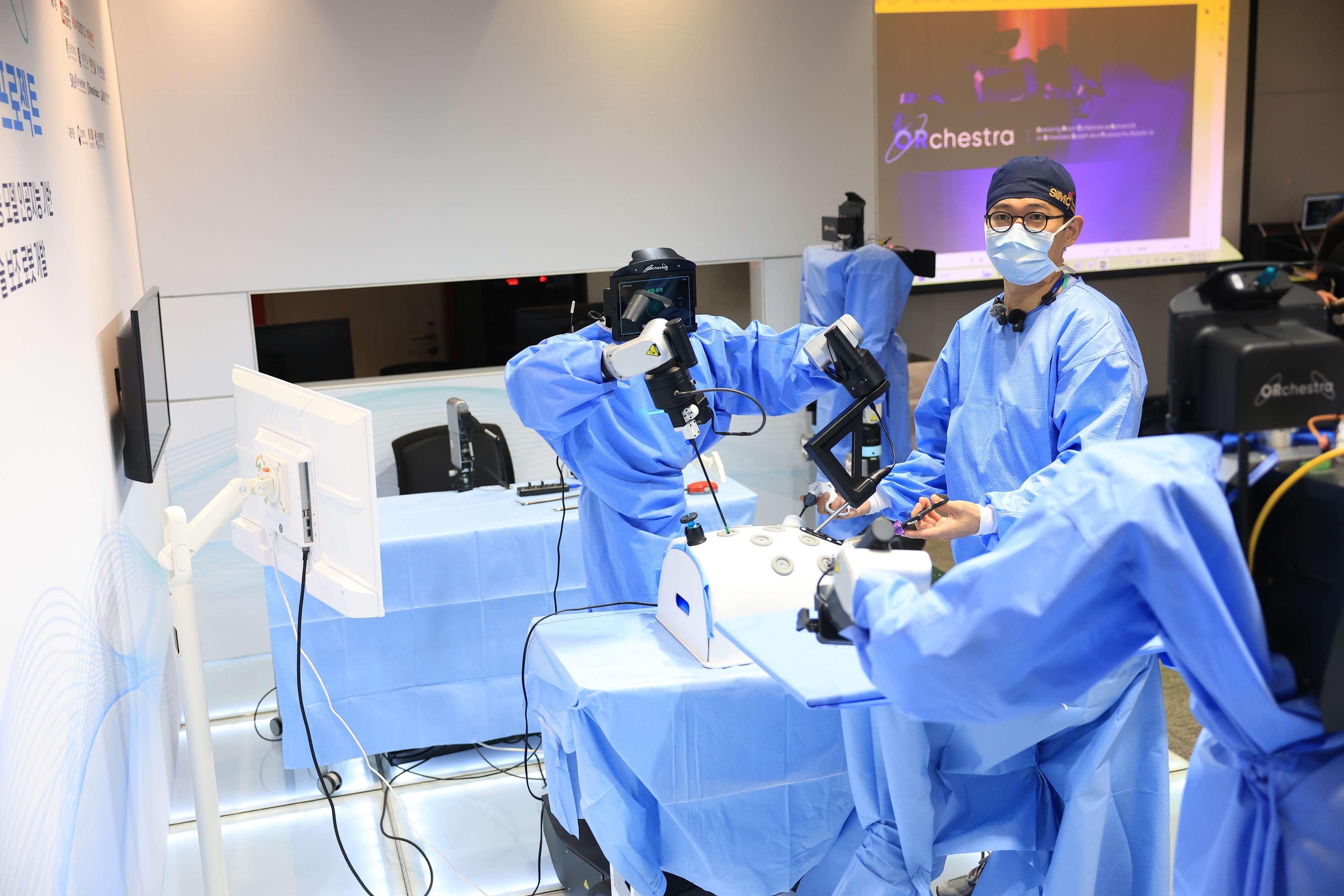
< In September, Samsung Medical Center demonstrated collaboration between two surgical assistant robots and a human surgeon for the first time in the world. Pictured are Professor Namkee Oh of the Department of Transplant Surgery and a robot during the surgical demonstration.>
When tested on CholecT45, a public surgical video benchmark on which researchers around the world compete under the same criteria, CurConMix+ achieved a mean average precision (AP_IVT) of 42.2%, surpassing the previous best-performing model (41.5%). On liver resection videos, it recorded 58.4%, more than 10 percentage points higher than previous models. The higher this value, the more accurately the AI recognizes instruments, actions, and targets in surgical video. Notably, recognition performance also improved for rare surgical actions that appear relatively infrequently in the training data.
For actions that are uncommon across the videos as a whole, such as applying clips to prevent bile leakage before the gallbladder is removed, average precision rose from 33% to 39% in gallbladder surgery videos and from 43% to 56% in liver surgery videos.
"For surgical robots to collaborate naturally with medical staff, they must go beyond simply identifying surgical instruments or organs and be able to understand what surgery is currently under way and what the medical staff are doing," Professor Kyu-Hwan Jung said. "This study is meaningful in that it presents an AI technology that recognizes surgery in an integrated way, from individual surgical actions to the overall surgical flow. We expect it to serve as a foundation for developing intelligent surgical robots that understand the surgical situation and proactively assist medical staff."
The research team also built a new dataset, LLS48, from approximately 52 hours of video covering 48 laparoscopic liver resections performed at Samsung Medical Center between February 2020 and March 2022. The dataset was organized into five surgical phases, 18 steps, and 195 actions in accordance with an international standard classification for surgical video, and two hepatobiliary-pancreatic surgeons and three specialists with more than 10 years of experience labeled and verified each scene.
Surgical AI research has until now been concentrated on cholecystectomy, and this work extends it to liver surgery. The dataset and code have been released on GitHub so that other researchers can validate the results as well.
What stands out is the model's scalability. The team also evaluated whether an AI trained on fine-grained surgical actions could recognize higher-level surgical phases. As a result, the model achieved an accuracy of more than 93% in predicting surgical phases in cholecystectomy. This demonstrates the potential to learn the hierarchical structure of the surgical process, beyond recognizing individual actions.
"In effect, an AI that learned fingertip-level movements went on to read the flow of the entire operation," Professor Namkee Oh said. "It could be used for automated documentation of surgical procedures, surgical review, and resident training, and ultimately for humanoid surgical assistant robots that recognize the intraoperative situation in real time."
This research was supported by the Korean ARPA-H Project, funded by the Korea Health Industry Development Institute (KHIDI) under the Ministry of Health and Welfare; a National Research Foundation of Korea (NRF) program under the Ministry of Science and ICT; the Samsung Medical Center Future Medicine 2030 Project; and a Samsung Medical Center research grant.
Publication Information
Title: CurConMix+: A Unified Spatio-Temporal Framework for Hierarchical Surgical Workflow Understanding
Journal: IEEE Transactions on Medical Imaging (IF 10.6)
Authors:
First author: Yongjun Jeon, Researcher, Clinical Robotics and Embodied AI Research Center, Samsung Medical Center
Corresponding authors: Kyu-Hwan Jung, Director, Clinical Robotics and Embodied AI Research Center, Samsung Medical Center; Namkee Oh, Professor, Department of Transplant Surgery, Samsung Medical Center
Link: https://doi.org/10.1109/TMI.2026.3745403