You finally get into bed after a long day, hoping to fall asleep quickly. But instead of drifting off, you find yourself staring at the ceiling, fully awake. The more you think about needing sleep, the harder it becomes to relax.
Sleep problems like these have become increasingly common. Long work hours, stress, irregular schedules, and constant exposure to smartphones and electronic devices can all affect sleep quality. Even people who feel physically exhausted may struggle to get truly restorative sleep.
In this edition of SMC News, we spoke with Joo Eun-Yeon, MD, sleep specialist in the Department of Neurology at Samsung Medical Center, about what healthy sleep really means and how daily habits can affect sleep quality and long-term health.
What Defines Healthy Sleep?

Many people think good sleep means falling asleep immediately, sleeping through the night without waking up, or never dreaming. But according to Dr. Joo, those expectations are often unrealistic—especially with age.
“Rather than chasing perfect sleep, what we should really aim for is healthy sleep,” she says.
Dr. Joo explains that healthy sleep depends on three essential factors: getting enough sleep for your age, maintaining good sleep quality, and following a regular sleep schedule that aligns with the body’s internal clock.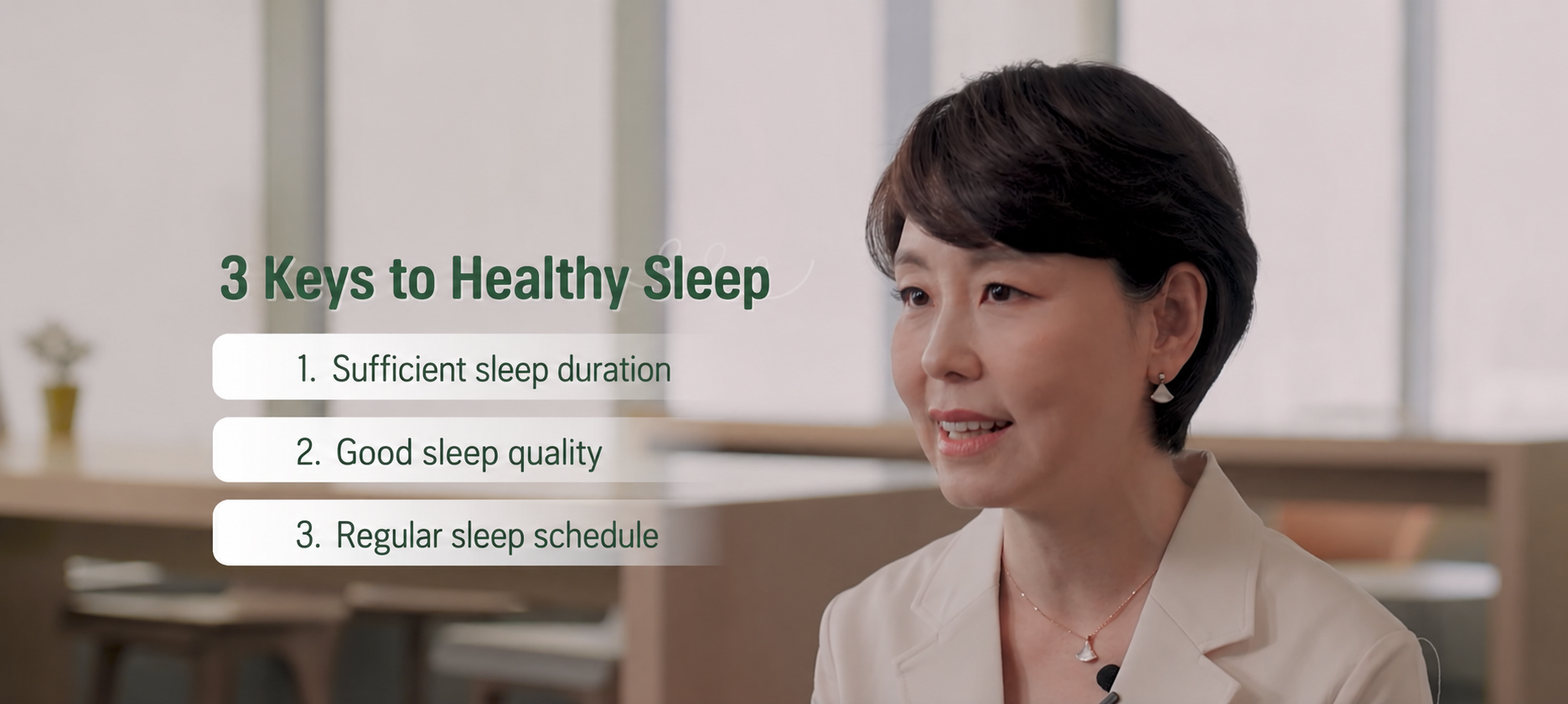
“These three elements need to work together,” she explains. “The ultimate goal of healthy sleep is to protect brain health, mental health, and physical health.”
For most adults, seven to eight hours of sleep is considered appropriate. Sleep quality also matters. Healthy sleep involves a natural balance between deep sleep and REM sleep, both of which are important for recovery, memory, and brain function. Maintaining regular sleep and wake times is equally important because the body’s circadian rhythm strongly influences energy levels, hormone production, and overall sleep quality.
Why Alcohol and Late-Night Eating Can Disrupt Sleep

Many people believe alcohol helps them sleep. Some even think drinking is better than taking sleeping pills. Dr. Joo strongly disagrees. “Alcohol is absolutely one of the worst choices for sleep,” she says.
Alcohol may initially make people feel sleepy because it suppresses REM sleep during the early part of the night. As a result, many people feel as though they are sleeping deeply during the first few hours after drinking. But the effect does not last. “As alcohol leaves the brain several hours later, REM sleep rebounds,” Dr. Joo explains. “That’s when people often wake up suddenly during the night.”
She adds that people with underlying sleep-related breathing problems may wake up feeling short of breath without realizing alcohol played a role. Over time, chronic alcohol use can also disrupt the brain’s natural balance between sleep and wakefulness. “The brain eventually shifts into a hyperaroused state,” she says. “At that point, even alcohol itself no longer helps people sleep well.”
Dr. Joo also warns that long-term excessive alcohol use may impair concentration, memory, judgment, and other higher brain functions. Late-night eating can create similar problems. Dr. Joo recommends finishing meals at least three hours before bedtime whenever possible. “When food enters the body, the digestive system immediately becomes active,” she says. “The brain also has to stay partially awake to support digestion.”
Heavy or greasy foods such as pizza, fried chicken, or bread may slow digestion even further. As a result, people may wake up feeling tired, bloated, or uncomfortable the next morning because the body spent much of the night digesting food rather than fully resting. She also advises avoiding excessive water intake before bedtime unless it is needed for medication.
“Many people think drinking large amounts of water before bed is healthy,” Dr. Joo says. “But nighttime urination can repeatedly interrupt sleep.”
How Caffeine and Light Affect Sleep

Some people believe caffeine does not affect them because they can still fall asleep after drinking coffee. However, Dr. Joo says sleep quality can still suffer even when falling asleep itself is not difficult. “Many people, especially men, say coffee doesn’t affect their sleep,” she says. “But often they begin waking up repeatedly during the night as they get older.”
People may describe symptoms such as light sleep, vivid dreams, or waking up feeling unrefreshed without realizing caffeine may be contributing. According to Dr. Joo, sensitivity to caffeine changes with age, and for some people, the effects can last far longer than expected.
“That’s why I usually recommend avoiding caffeine within 12 hours of bedtime,” she says. For people who feel sleepy during the afternoon, Dr. Joo says a short nap may be more helpful than relying on caffeine.
“Our energy levels naturally dip in the afternoon because of the body’s circadian rhythm,” she explains. “A brief 30-minute nap is often the healthiest way to recover energy.”
Light exposure also plays an important role in sleep health. Morning sunlight helps wake up the brain and supports healthy melatonin production later that night. Dr. Joo recommends getting adequate light exposure during the morning and daytime whenever possible. In contrast, bright light exposure in the evening can interfere with sleep. “If you use your smartphone in bed or keep bright overhead lights on late at night, melatonin production may be suppressed,” she says.
To support better sleep, she recommends reducing bright light exposure in the evening and using softer lighting at night whenever possible.
Creating a Better Sleep Environment

The ideal sleep environment can differ from person to person. Some people find ASMR or white noise relaxing and helpful for sleep, while others are highly sensitive to even small background noises. “If ASMR helps you relax and fall asleep more comfortably, that’s perfectly fine,” Dr. Joo says.
However, she notes that electronic devices themselves may still create problems because of light exposure. “If you listen to ASMR on your phone, try placing the phone face down so the light doesn’t continue stimulating the brain,” she explains.
Wearable sleep-tracking devices such as smartwatches may also help people better understand their sleep patterns. “Modern wearable devices are more accurate than many people expect,” Dr. Joo says. “They can provide useful information about sleep duration and sleep timing.”
As for sleep supplements such as chamomile tea, lavender tea, or melatonin products, Dr. Joo says responses vary from person to person. “If you feel they help, it’s reasonable to continue using them,” she says. “But many sleep supplements are not medications, and in many cases their effects may be limited.”
She also points out that health supplements and medications are fundamentally different. “Medications go through extensive testing for dosage, side effects, and safety,” she explains. “Health supplements are different because they are not tested in the same way.”
Why a Regular Sleep Schedule Matters
According to Dr. Joo, one of the biggest obstacles to healthy sleep is an irregular lifestyle. Many young adults develop inconsistent sleep schedules because of work, studying, commuting, or social activities. While younger people may tolerate irregular sleep temporarily, long-term disruption can eventually affect the brain’s biological clock.

“When irregular sleep patterns continue for years, the body’s internal clock can gradually break down,” Dr. Joo says.
She explains that many people try to compensate for sleep deprivation during the weekend by sleeping much later than usual. However, large differences between weekday and weekend sleep schedules can create what specialists call “social jet lag.”
“It’s similar to living in one time zone during the week and traveling to another on the weekend,” she explains. According to Dr. Joo, long-term social jet lag has been associated with increased risks of cardiovascular and cerebrovascular disease. To reduce this effect, she recommends keeping bedtime relatively consistent while using weekends mainly to extend wake-up time rather than drastically delaying sleep.
Healthy Sleep Habits Throughout the Day
Healthy sleep begins long before bedtime. Daily routines throughout the entire day can influence how well the body rests at night. In the morning, waking up at a consistent time is especially important. “You may not sleep perfectly every night, and bedtime can vary,” Dr. Joo says. “But the time you get into and out of bed should remain as consistent as possible.”
Morning sunlight and a light breakfast can also help the body transition into wakefulness. Dr. Joo notes that breakfast does not need to be large—even something simple, such as nuts or soy milk, may help activate the body’s systems. In the afternoon, many people experience significant drowsiness after lunch. Instead of relying on coffee, Dr. Joo recommends resting briefly whenever possible.
“Even closing your eyes for 10 minutes at your desk can help more than people realize,” she says. In the evening, reducing stimulation becomes increasingly important. Dr. Joo encourages people to create time to relax and release stress accumulated throughout the day. Listening to music, reading, or quietly watching videos may all help the body transition into rest mode. However, she recommends avoiding bright ceiling lights and reducing smartphone use before sleep.
“Ideally, try not to bring your phone into bed,” she says. For people whose thoughts become overwhelming at night, Dr. Joo also recommends leaving the bed temporarily rather than forcing sleep.

“If worries keep circling in your mind, get out of bed and sit somewhere calm,” she says. “Write those thoughts down.”
She explains that putting worries onto paper often helps people view them more objectively and reduces nighttime anxiety.
“When thoughts stay only inside the mind, they can feel much bigger,” she says. “Writing them down can make a surprising difference.”
Better Sleep Starts with Everyday Habits

From alcohol and caffeine to light exposure and daily routines, many small habits can have a significant impact on sleep quality.
According to Dr. Joo, healthy sleep is not about sleeping perfectly every night. Rather, it is about building consistent habits that allow the brain and body to recover properly over time.
“Good sleep is created through daily routines,” she says.
“When your sleep schedule becomes more stable, your body and mind can function at their best.”