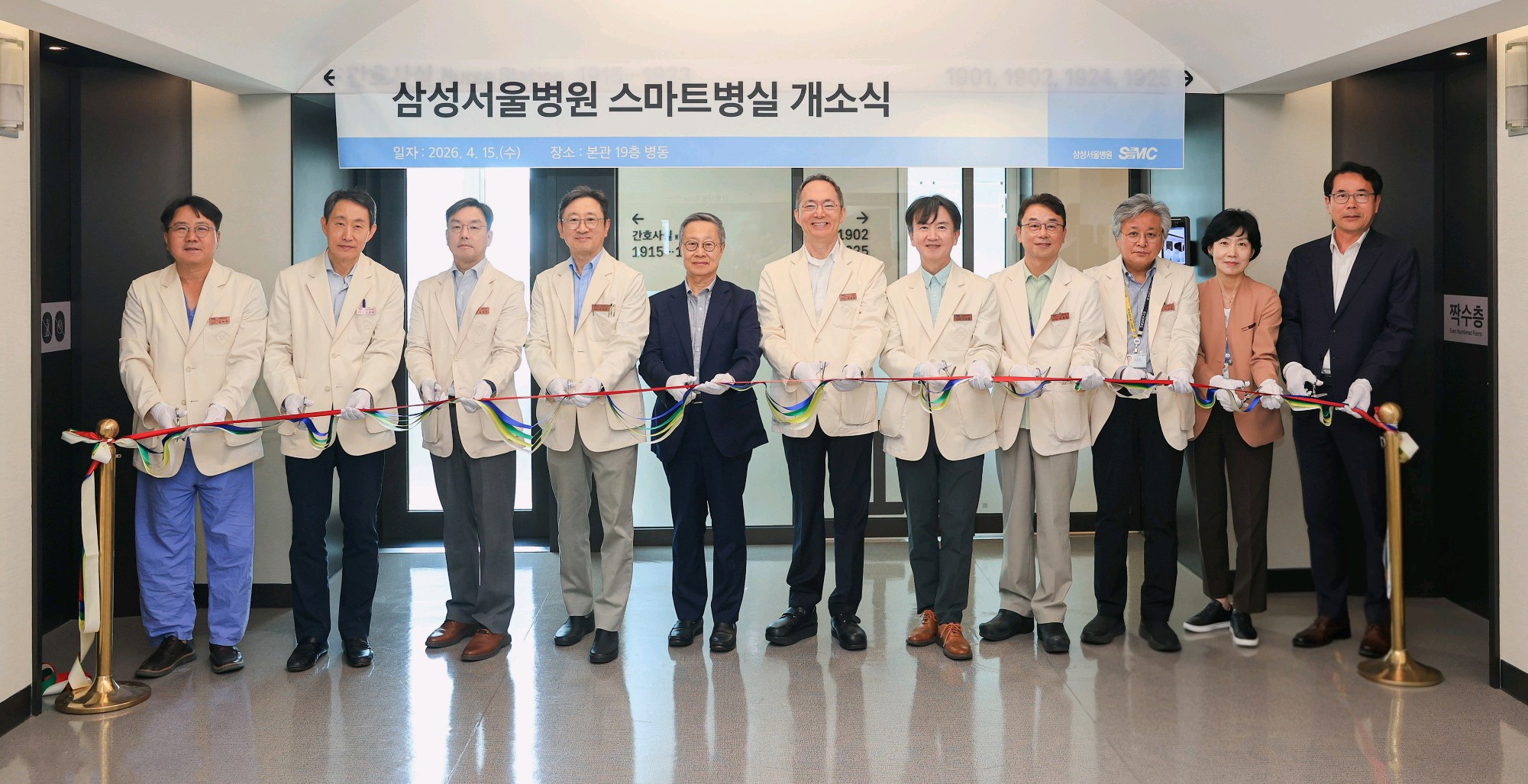
Samsung Medical Center has launched its "Smart Ward," a patient-centered initiative designed to transform the inpatient care environment. This introduction represents far more than a one-off technology deployment — it marks a significant milestone in the institution's long-term transition toward becoming an advanced intelligent hospital.
Since its founding, Samsung Medical Center has been at the forefront of digital innovation in Korean healthcare, advancing a concrete vision for the future of medicine through achievements such as top-tier HIMSS certification, a digitally driven patient experience (Digital CX), and a shift toward robot-based automation. The newly opened Smart Ward is a tangible outcome of this ongoing journey, simultaneously enhancing patient safety, convenience, and clinical workflow efficiency.
Samsung Medical Center has been pursuing phased improvements to its inpatient environment since 2020. Based on a satisfaction survey of approximately 1,000 discharged patients conducted in 2023, the hospital identified key areas for meaningful enhancement. Subsequently, the Remodeling and Innovation Task Force under the Heart Vascular Stroke Institute was established to develop the concept and operational framework of the Smart Patient Room project.
Professor Sang Chol Lee, Executive Vice President, General Director of Heart Vascular Stroke Institute (Division of Cardiology), noted, "The Smart Ward goes beyond simply adopting new technology — the focus was on connecting patient safety and the overall care experience into a seamless continuum."
Smart Ward: Enhanced Convenience, Monitoring, and Safety Management
The Smart Ward features a facial recognition-based access system for inpatients, ensuring both convenience and security. Inside the room, patients can control their environment — including the TV, lighting, temperature, and curtains — via a dedicated tablet. They can also view real-time information such as test results, appointment schedules, and meal preferences, and communicate with clinical staff through chat, voice calls, or video calls.
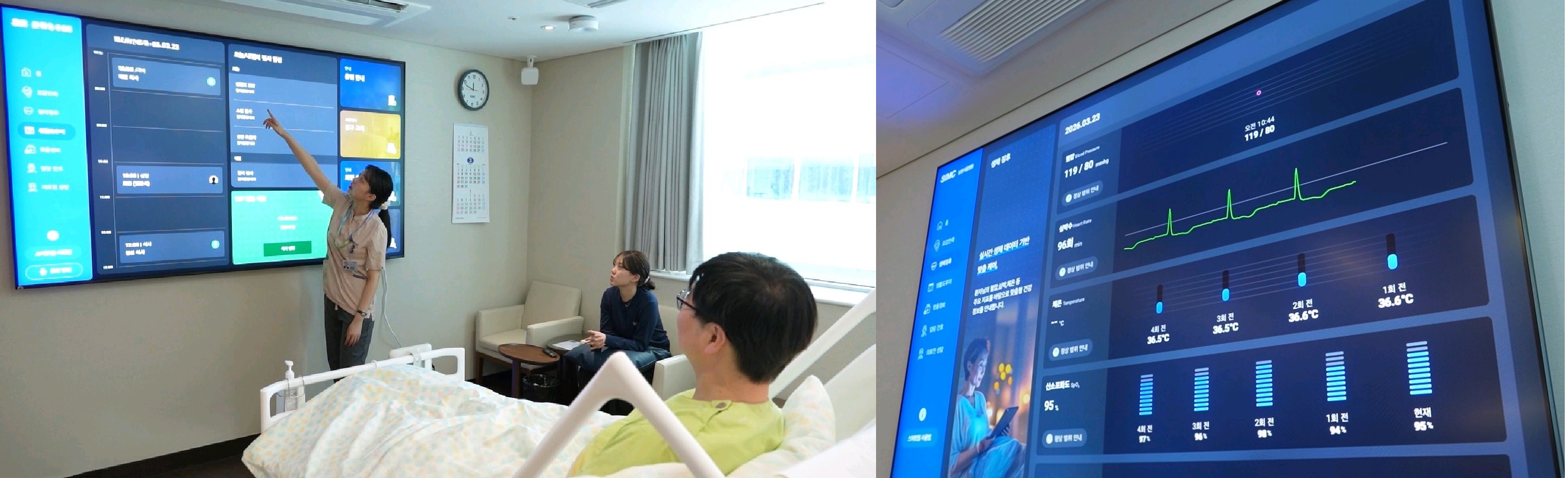
This information and control interface is also accessible on a large in-room display, enabling patients and their families to review it together and strengthening communication among patients, caregivers, and clinical staff. The dedicated tablet also supports voice recognition, making it easier for patients with limited mobility — such as those recovering from surgery — to operate independently.
The monitoring capabilities of the Smart Ward are equally noteworthy. AI-powered ultra-compact wearable devices enable continuous tracking of vital signs including blood pressure, electrocardiogram (ECG), and oxygen saturation. This minimizes the need for late-night clinical rounds for vital sign measurement, contributing to a better sleep environment for patients. The collected data can be reviewed directly by patients via the tablet, and is simultaneously accessible to clinical staff in real time, enabling rapid response in the event of an emergency. During sleep, the system also monitors sleep stages and offers music to promote restful sleep.
Radar-based sensors installed throughout the room, including in the bathroom, detect early signs of patient falls and automatically alert the nursing station. In the bathroom, a smart toilet measures pulse rate and body temperature, displaying the readings on a smart mirror; if an abnormal reading is detected, a voice alert is triggered to prevent potential harm.
The Smart Ward also improves operational efficiency for healthcare professionals. Instead of requiring clinicians to participate in video production, educational content can be entered into the system, which then automatically generates patient education videos using AI avatars. Through these videos, patients receive personalized educational content directly in their rooms, while healthcare professionals can reduce repetitive explanatory tasks and devote more time to direct patient care.
Companion robots are also being piloted in the Smart Ward to support patients' emotional wellbeing and enhance the overall inpatient experience. Through simple interactions with patients, the robots are intended to provide psychological comfort, while also serving as a platform to evaluate a range of potential applications for future Smart Ward enhancements.
Professor Kyoung Min Park, Chief Remodeling and Innovation Officer (Division of Cardiology) and lead of the Smart Ward initiative, emphasized: "We have created an environment that enables continuous monitoring and early detection of emergencies without disrupting patients' rest, and have reinforced patient safety management by accounting for spaces that could otherwise become blind spots."
Accelerating AI Transformation Toward an Advanced Intelligent Hospital
Building on the launch of the Smart Ward, Samsung Medical Center plans to accelerate its ongoing transformation into an advanced intelligent hospital. Based on operational outcomes from the Smart Ward, the hospital is actively exploring further expansion across the facility and the integration of additional AI capabilities.
Samsung Medical Center has already secured domestic and international patents for its AI-based hospital operations platform, DOCC (Data-Based Operation & Communication Center, a predictive management platform), underscoring the institution's strong momentum in AI-driven transformation.
President Seung Woo Park stated, "The Smart Ward is the embodiment of Samsung Medical Center's vision — using technology to deliver more compassionate care and to advance toward becoming an advanced intelligent hospital. We will continue to set new standards for the future of medicine through patient-centered innovation."
Meanwhile, Samsung Medical Center has ranked first in South Korea for four consecutive years on Newsweek's "World's Best Smart Hospitals" list.