When a child has recurring pus or pain around the anus, families often hesitate to seek care—feeling embarrassed or assuming it is a simple skin condition. As a result, pediatric Perianal Fistulizing Crohn’s Disease (PFCD) frequently goes undiagnosed until later than it should.

An important clue has now emerged for treating this condition, which is especially common among pediatric patients in East Asia. A research team led by Professor Mi Jin Kim of the Department of Pediatrics and Professors Joon Hyuk Son and Sung Joo Park of the Department of Pediatric Surgery at Samsung Medical Center recently published a study in Frontiers in Pediatrics revealing the relationship between blood infliximab levels and fistula healing in children with perianal Crohn's disease.
The study analyzed 82 children and adolescents under the age of 18 who received infliximab treatment for pediatric perianal Crohn's disease—the largest study published on this topic to date.
One year after starting treatment, the team objectively assessed fistula healing using MRI, finding radiologic healing in approximately 70 percent of patients (57 children). When comparing those whose fistulas healed with those whose did not, the key difference in outcome came down to the drug's trough level in the blood.
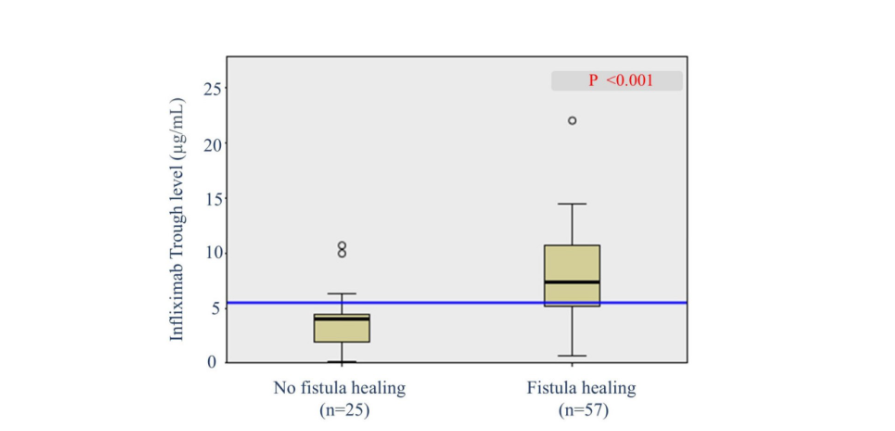
The team explained that "patients in whom healing was confirmed tended to maintain higher drug levels at both week 6 and week 54 of treatment," and that "the drug concentrations at these two time points were identified as independent predictors of healing." The optimal threshold values they proposed were 9.7 μg/ml at week 6 and 5.1 μg/ml at week 54; patients who maintained these levels showed significantly higher rates of fistula healing.
The team interpreted these findings to mean that consistently monitoring blood drug levels from the early stages of treatment and adjusting the dose for each individual patient is important for improving treatment response. The study also established that MRI findings can serve as a benchmark for guiding treatment decisions.
Pediatric perianal Crohn's disease directly affects a child's growth and development, yet it remains difficult to treat. Improvement in symptoms does not always mean the fistula has fully closed, and internal inflammation often lingers. The team noted that they "defined healing using stricter, more objective criteria by reading T2-weighted images together with contrast-enhanced T1-weighted images."
The team also emphasized the importance of a multidisciplinary approach in pediatric perianal Crohn's disease, since the condition is difficult to resolve with surgery or medication alone. Samsung Medical Center operates a dedicated multidisciplinary team—including Professor Yon Ho Choe along with Professors Mi Jin Kim, Yi Young Kwon, and Yoonzi Kim of the Department of Pediatrics, and Professors Jeong Meen Seo, Sang Hoon Lee, Joon Hyuk Son, and Sung Joo Park of the Department of Pediatric Surgery—specializing in pediatric Crohn's drug dosing calculations, anatomical classification of fistulas, and long-term follow-up care.
Professor Mi Jin Kim, who led the study, said, "When symptoms such as anal pain, pus discharge, or recurrent abscesses are present, they should not be dismissed as a simple skin condition—it is important to seek a professional evaluation early." She added, "When early diagnosis is paired with the right treatment strategy, families can look forward to a favorable long-term outcome."