
Colorectal cancer is known to have a relatively high survival rate when detected early. According to data released by the Korea Central Cancer Registry in 2026, the five-year relative survival rate for localized cancer—the stage corresponding to early colorectal cancer—reached 94.9% for the 2019–2023 period. For such early-stage disease, the standard approach is to remove the tumor endoscopically and then monitor the patient's prognosis.
However, the standard guideline calls for additional surgical resection of the bowel surrounding the tumor site whenever even a single risk factor is identified after endoscopic resection—for example, invasion of the surrounding lymphatic vessels, blood vessels, or nerves; detachment of cancer cells (tumor budding); poor differentiation; or deep submucosal invasion.
This additional surgery is intended to completely eliminate any cancer that may remain in the lymph nodes or elsewhere. Given that the disease is early-stage colorectal cancer, however, the burden it places on patients is considerable, and the treatment has frequently been regarded as excessive. In fact, examinations of patients who underwent additional surgery after endoscopic resection have reported that 80–90% had no lymph node metastasis.
A research team led by Professors Hee Cheol Kim and Jung Kyong Shin of the Division of Colon and Rectal Surgery at Samsung Medical Center has published new criteria for distinguishing which early colorectal cancer patients truly require surgery after endoscopic resection from those who do not, in a recent issue of the Annals of Surgical Oncology.
The criteria are drawn from the team's analysis of 1,162 patients who underwent additional surgery after endoscopic resection for early colorectal cancer (T1) at Samsung Medical Center between 2004 and 2024. According to the study, cancer cells were found in the lymph nodes of 148 of these patients (12.7%). On this basis, the team developed the Composite Pathologic Score.
The Composite Pathologic Score evaluates five items following endoscopic resection of early colorectal cancer, assigning one point for each that applies: invasion of the lymphatic vessels, blood vessels, or nerves; tumor budding of five or more; poor differentiation; submucosal invasion of 2,000 micrometers (μm) or deeper; and cancer tissue identified at the margin of the endoscopically resected specimen.
On the 5-point scale, the team classified a score of 2 or higher as high-risk and anything below that as low-risk.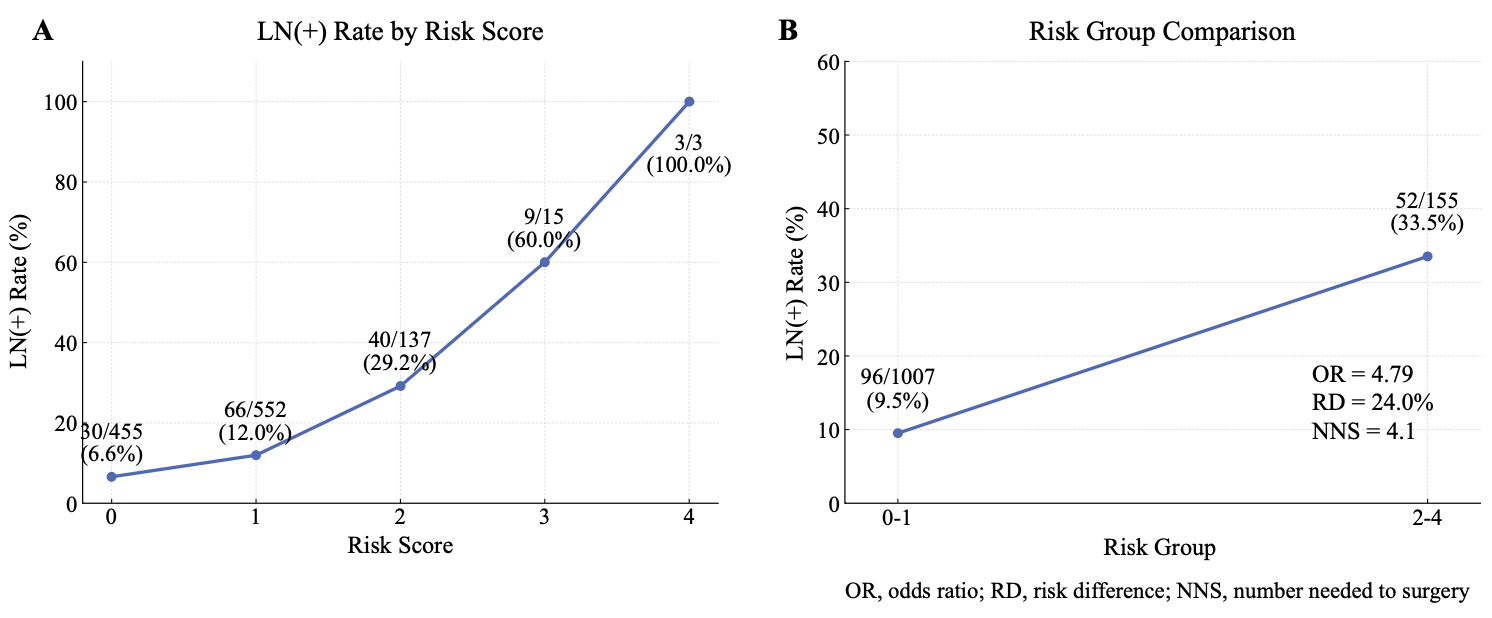
The team reported that among patients with a Composite Pathologic Score of 0—those meeting none of the new criteria—only 6.6% had lymph node metastasis. Lymph node metastasis was confirmed in 12% of patients scoring 1, 29.2% of those scoring 2, 60% of those scoring 3, and 100% of those scoring 4; no patient scored 5. The contrast was likewise pronounced between the low-risk group (scores 0–1), with a lymph node metastasis rate of 9.5%, and the high-risk group, at 33.5%.
Accordingly, the team emphasized that additional surgery after endoscopic resection for early colorectal cancer warrants careful consideration. When a low-risk patient with a Composite Pathologic Score of 0–1 faces a high surgical burden because of advanced age or other comorbidities, the team concluded, active surveillance is more advantageous to the patient than proceeding with surgery unnecessarily.
Professor Hee Cheol Kim, Executive Vice President of the Samsung Comprehensive Cancer Center, said, "Even for cancer patients, it is only natural to identify those who truly need surgery and to operate accordingly." He added, "We will develop more sophisticated and precise surgical criteria to improve cancer patients' quality of life and to help establish a culture in which patients' right to self-determination is more fully respected."
Since it opened in 2008, the Samsung Comprehensive Cancer Center has managed not only treatment outcomes but also patient experience and quality of life as core measures of treatment performance.
In 2024, it established the Institute for Quality of Life in Cancer together with Samsung Fire & Marine Insurance, and it is concentrating on research and the development of support programs to improve cancer patients' quality of life across the entire course of their lives.
It has also held bimonthly joint seminars on Patient-Reported Outcomes (PRO) since 2024 with Charité in Germany—regarded as one of Europe's premier hospitals—steadily expanding its international collaboration.
Most recently, the Samsung Comprehensive Cancer Center signed a memorandum of understanding (MOU) with the European Organisation for Research and Treatment of Cancer (EORTC), Europe's largest cancer clinical research body, to serve as the official partner overseeing the standardization and quality control of Korean-language PRO instrument translations. It also became the first institution in Korea to earn certification from the International Consortium for Health Outcomes Measurement (ICHOM), a nonprofit organization that sets international standards for patient-centered, value-based healthcare.
The Samsung Comprehensive Cancer Center additionally ranked third in the world for the second consecutive year in the global cancer hospital rankings released by Newsweek in 2025.
New Criteria for Early Colorectal Cancer: Surgery "Only for Patients Who Truly Need It"
Meet SMC Doctors
Hee Cheol Kim
Professor, Department of Surgery, Samsung Medical Center, Sungkyunkwan University School of Medicine, Seoul, Korea
Colorectal Cancer, Rectal Cancer, Hereditary Colorectal Cancer, Metastatic Colorectal Cancer, Robotic Surgery, Laparoscopic Surgery, Single-Port Laparoscopic Surgery
Jung Kyong Shin
Assistant Professor, Division of Colon and Rectal Surgery, Samsung Medical Center
Colorectal Cancer, Rectal Cancer, Hereditary Colorectal Cancer, Metastatic Colorectal Cancer, Laparoscopic Surgery, Robotic Surgery, Single-Port Laparoscopic Surgery, Colorectal Disorders